 by
Lynn and
John Salmon
by
Lynn and
John Salmon
by
Lynn and
John Salmon
by
Lynn and
John SalmonActually, you can; it just takes time and a little luck. Pitcairn Island is one of those magical places that is quite real, but has an almost fictional aura. It's a tiny volcanic rock in the middle of the South Pacific. It's inhabited by descendants of the Bounty mutineers and their Tahitian companions. It derives much of its income from philately, yet receives mail (and all other goods from the outside) only three or four times per year. Its coastline is one of the least hospitable on earth, yet its people must be among the friendliest. It's extraordinarily hard to get there, and even after travelling thousands of miles many travelers are forced to turn back a few hundred meters short of their goal due to impossible conditions in Bounty Bay.
Our trip begins with the World Heritage List. We have been focusing our travels in recent years on the World Heritage areas, and became intrigued by Henderson Island. Henderson Island is a tiny, uninhabited speck of land in the middle of the South Pacific. Its nearest inhabited neighbor is Pitcairn. We decided that Henderson was surely the most difficult World Heritage site to visit (barring political, social or legal difficulties) so we made a special effort to find out a little more about it. Among other things, Lynn made a www-page on which she solicited any additional information people might have.
One day last year we received an email from Frank Robben that said
I am returning to Pitcairn, Henderson and Mangareva about May-June 1997 and would take any interested people from Mangareva to Pitcairn, Henderson or other close places during that time. Do you know anyone interested? A somewhat unique opportunity. Please visit my home page for more info.
This came as a complete shock! Truly, we had never expected to get to Henderson Island, and now the opportunity was within our grasp. What would we find there? No matter what, it was bound to be a unique and once-in-a-lifetime adventure. We hadn't done an expedition in quite a while, and it looked like a cruise in the South Pacific could be fit around our work schedules. After much discussion, and even a highly eventful trip to Ensenada to meet Frank and see the Kialoa II, we decided to make the trip.
As with all great travel, the people and things one meets along the way are more important and leave more lasting impressions than the putative "goal". Although beautiful and unique, Henderson and its birds cannot compete with Pitcairn and its people for a place in our hearts.
We had little choice on when to come to Tahiti. There are only 3 flights to Mangareva this month so our itinerary was based around the dates of the Papeete-Mangareva connections. Today is Sunday and Papeete pretty much rolls up the streets and closes down for the day. Even the boutiques selling black pearls are closed, and with the money they spend on advertising, it's hard to believe that they'd allow a tourist to escape without the chance to buy. We do see one thing that interests us: an art dealer has some wood-carvings with some interesting abstract designs - but they too are closed. We will return on a Sunday as well, so it seems we will not have an opportunity to buy any artwork on this trip.
Our guide books are little help, but they suggest that the 'Lagoonarium' is open on Sundays. The Lagoonarium is a "roadside attraction" attached to Captain Bligh's restaurant. It's an extremely tacky, though pleasant, underwater aquarium. The entrance is through an archway that looks like a giant shark's mouth. The shark's intestinal track is illustrated and labelled in the passageway leading downstairs to an underwater viewing area. The water was a bit cloudy, but there were a number of fish to see including a lot of sharks (black finned reef sharks), and some of our old favorites from owning salt-water aquaria at home: damsels, Picasso fish, and Moorish Idols. More exotic species included some rays, a turtle and a stone fish.
Lunch at Captain Bligh's was very expensive, and as we shall see, prices in Papeete are uniformly high. Taxi fares compete with food prices for outrageousness. If we did the day over we would rent a car and drive around the island. The normally inexpensive public transportation, Le Truck, doesn't run on Sunday's and taxi fares are expensive enough to make a car rental worthwhile just for a trip out to a restaurant and back. Papeete is little more than a way-point for most travelers to French Polynesia, who are on their way to the more picturesque and accommodating outer islands. It has third world ambiance with first world prices.
We woke up early and went to breakfast where we met our fellow traveler for the next couple of weeks, Mike Halasz. Mike also joined our expedition because of an unsolicited email. This one, however, came from us.
Frank Robben had planned to operate two trips to Pitcairn. They were to be organized by Ocean Voyages, an agent for yachting cruises based in California. However, Frank became dissatisfied with Ocean Voyages (they failed to provide him with a satisfactory explanation of why they were charging guests so much, yet Frank was to receive only US$80/guest/day), and canceled all further business with them.
At this point, Frank was in Ensenada and we were the only people he knew who were committed to making the trip. He asked us if we'd try to find a few more guests to help defray the cost of the trip, and also if we'd act as point of contact for communication with him (telephone, fax and email service are a lot more reliable in Pasadena than in Ensenada). We agreed, and sent an email to an old mailing list inviting "Friends of Pitcairn" to join our trip.
We had been hoping that perhaps someone with sailing experience would join us. Alas, Mike had just about exactly the same qualifications we did: reasonable good-health and a good attitude - but essentially no sailing experience.
We all take a taxi to the airport. Mike has only French francs which are not the universally accepted money in French Polynesia that he was led to believe. Airport check-in was a breeze, requiring no special documents. This was a point of some concern because we had made numerous phone-calls to travel agents, travel bureaus and various agencies of the French government, and received numerous inconsistent stories about the need for special permission to travel to Mangareva. As best we can tell, there had been some restrictions during the recent nuclear testing and associated protests, but there are no restrictions in effect now. The flight to Mangareva stops at the island of Hao, which is a French air and naval base used to supply the nuclear testing facilities at Mururoa.
It was a full flight of 46 persons for the first leg to Hao. From the air, Hao is quite spectacular. It's an almost complete low circular atoll several miles in diameter. The air strip is really, really long. After touching down we taxied for a very long time before reaching the terminal. Approximately 2/3 of the passengers disembarked and the rest of us flew onward to Mangareva. On the plane we met Johnny Raisin, an exiled character whose family lives alone on Kamaka Island, though he has a little house in Rikitea for when he's in town.
The plane landed on the airstrip located on Totegegie, a long thin motu in the Gambiers. We had to ferry across to the main town of Rikitea on Mangareva. There was some confusion about the bags and the boat to the other island. Our bags were almost left in a pile on the runway, but in the end everything was loaded and crossed the lagoon. Mangareva is the largest island in the group and Rikitea is the only population center of any size. Rikitea also has a well-protected harbor, so all the yachties stay there.
We were quite happy, and relieved to see Kialoa II was anchored in the harbor. Frank Robben had set off from Ensenada a month previously with his family and two guests. Our only communication since had been an email message a few days before our departure that said he was on the way to Mangareva. Kialoa II was to be our home away for home for the next 19 days.
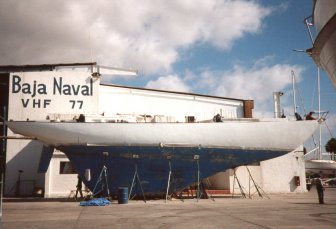 [Kialoa2 being overhauled in Ensenada]
Kialoa II is a large, comfortable sailing yacht owned by Frank Robben. He and his wife Cynthia, 3 children plus 2 guests, Matt and Judy Johnston, had spent the last month sailing from Ensenada where the boat had been thoroughly overhauled. They had stopped briefly on Pitcairn Island where they left the 3 children. Daphne Warren, a Pitcairn native, and Del Barnes from NZ joined the Kialoa II in Pitcairn for a holiday to Mangareva. Del's husband is a mechanical engineer currently working on Pitcairn.
In the morning we "learned" a little about the boat. We spent a couple of hours coiling lines and folding sails, etc. The main had to be raised and then re-lowered, so we got our first opportunity to man the cranks. John helped with the sail covers which involved climbing out over the stern and reaching as far as he could to get to the snaps. There's lots of cordage and every piece of it has a unique name. Kialoa II is the largest of ~8 sailboats anchored in the sleepy harbor of Rikitea.
It's a beautiful sunny day, perfect for seeing the town. Mike, Matt, John and I got to explore most of the town of Rikitea while seeking a place to dispose of 2 gallons of used motor oil. If you're ever in a sleepy tropical village, and you want to meet all the local movers and shakers, there's no better way to do it than to go on a quest for a place to dispose of used motor oil. First, we asked at the post office and were told to just dump it anywhere. Asking the gendarmes produced much discussion (Mike speaks French, John barely understands French, and the rest of us were completely lost) and eventually resulted in directions to Phillipe who may take it. He didn't want it, but suggested Michel, who in turn suggested someone else, and so we progressed back and forth across town. Of course, "directions" in Rikitea are along the lines of "A couple of houses past the quay, ask for Michel". Finally someone at the Sacred Hearts of Quebec vocational school took the oil off our hands. The school is a missionary undertaking that teaches trades (e.g., machining, auto repair, etc.) to young islanders. These skills are useful in the outside world, and have helped to alleviate poverty on the island. Apparently, the island had been fairly poverty-stricken until quite recently but now, after the introduction of pearl farming, the general standard of living seems modest but comfortable.
Afternoon brought a trek across to the other side of the island on a "shortcut" path that goes up and over the middle instead of around the perimeter where the road is. While small, it is still probably 10 miles around the island by road. Since the island is longer than it is wide, the shortcut across the middle was only one mile. En route, we had a picnic lunch of breadfruit and papaya. The breadfruit is sort of like potato, filling, caloric and kind of bland.
Breadfruit is crucial to the history of Pitcairn island. The Bounty had been on a mission to acquire viable breadfruit seedlings from Polynesia and return them to the West Indies where they were intended to be grown as food for the slaves. The mission, of course, was a failure. Nine crew members, under the leadership of Fletcher Christian, staged a mutiny on April 28, 1789. After several months at sea, and several abortive attempts to create a settlement on inhabited islands, they eventually made their way to Pitcairn, which at the time was incorrectly located on British maritime charts. Their descendants still live on Pitcairn and we shall soon meet them. Captain Bligh and 18 other loyal officers and crew were put in an open boat and left for dead. By an amazing combination of good luck and superb seamanship, all but one arrived alive at the Dutch colony on Timor, some 3600 miles away, on June 13, 1789. Bligh returned to England, and was given commission of a second breadfruit mission. The second mission was a tactical success but a strategic failure. The breadfruit was never widely adopted in the West Indies. For some reason (not reported in the accounts I have seen) the Jamaican slaves refused to eat the breadfruit. I find this somewhat difficult to understand. Breadfruit is a perfectly good, and very versatile food, though I'm sure one would grow tired of it after a while. Perhaps it was served uncooked, in which case it would be like eating raw potato - and is probably indigestible.
The path across the island was wide and clearly marked and we came out on a road near a small shrine. A short distance down the road, we passed a steel and concrete structure with no identifying markings that couldn't possibly be anything other than a fallout shelter. It's a VERY serious building. Dark. Foreboding. We venture a few steps inside, but then somebody mentions the possibility of snakes, and we don't linger long enough to let our eyes adjust to the darkness. At dinner a couple of nights later we are told that the entire population of the island was required to stay in these fallout shelters for weeks at a time when the French were conducting above-ground nuclear tests in the 1960s. The idea sends shivers down the spine. One wonders how high-level support for testing the "force de frappe" would fare if one or two randomly chosen Parisian cabinet ministers were required to join the Mangarevans in this shelter for a couple of weeks.
We walked north for a mile or so and reached Andrew and Crystal's pearl farm. Crystal, who speaks English, went out of her way to show us the whole operation. With 60,000 oysters under cultivation it's a tremendous amount of work. Crystal and Andrew took us out on a boat to get a better look at the lines of oyster nets strung between floats in the water. We pulled up several different growth stages. Baby oysters are "caught" on plastic mesh bags full of "miki miki" wood from the motus (low islands that form the outer limits of the atoll). They are transferred to individual hanging baskets (12 per basket) where they grow to about 6 inches across. The oysters live for 14 or 15 years and produce a pearl every second year. They must be pulled out and cleaned periodically, as well as seeded and harvested. Andrew's family owns the farm, and the couple live fairly simply in a house overlooking the sea.
Back at the shed we get to watch Andrew seed one, using stainless steel tools that look like they come from a dentist's office. The nuclei are Mississippi River shell of some kind. The modern pearl you buy at the jewelry shop in Papeete, New York or Tokyo is only a mm or 2 of nacre over a "marble" sized nucleus. There are also "kashi" which are "accidents" from bits of shell or other irritant getting in the oyster. The kashi frequently grow in odd shapes and come in a variety of sizes and colors. They don't have the snob appeal of a "real" pearl (after all, who wouldn't covet a $10,000 item that's 90% Mississippi River clamshell), but they are much more aesthetically interesting.
It was getting dark as we finished our tour, and Crystal gave us a ride back to town around the perimeter of the island. This was our only look at the north end of the island. The road rises and falls as it passes by small inlets and the occasional cluster of houses. We pass a couple of fairly new vehicles on the way (Toyota pickups are popular). It seems that pearl farming has brought an unprecedented prosperity to the island There are children playing everywhere, and they seem cheerful and well-fed. Adults are frequently seen working on their homes (adding additions) or in their gardens. It's bustling, but laid back.
During the day we visited with Johnny Raisin (aka Johnny Kamaka). Johnny can possibly be best summed up by his reply when Mike asked him "What do you do in Mangareva?" His reply, "I live." He's a classic island character, part buccaneer, part aging hippie, part established property owner. His bio would be fascinating, but he's pretty tight-lipped about it. Rumor has it that his legal situation is "delicate", and he is "required" to keep to himself on his beautiful and remote island of Kamaka. We chat him up about the trail up Mt. Duff, and good nearby islands to visit. He's planning to pour a slab for his in town digs, so we unfortunately can't visit his island in the next day or two.
Johnny doesn't make any secret of his opinion of French nuclear testing. His house is easily recognized as the one the that says "Nuclear free Pacific" in four languages (English, French, Tahitian and Mangarevan). Nevertheless, he's confident that Mangareva will not suffer any long-term damage from the testing as a Greenpeace friend of his took water and soil samples from all over the island and declared it clean. We mention the recent (June, 1997) issue of National Geographic that contained an article on French Polynesia and another on black pearls. Of course, Johnny knew all about it since one (or more) of the National Geographic crew stayed with him while they were here.
Daphne is keen to buy some black pearls, and has been asking around. Surprisingly, none are available. Although many of the pearl farms are owned by "The Chinaman" (a wealthy landlord/tycoon featured in the National Geographic article), many more are privately owned and are worked by their owners. Nevertheless, even after asking around, there is still nothing to be found. There appears to be no market at all, presumably because not enough foreigners visit Mangareva. Essentially all pearls are sent to Tahiti and beyond for sale. We do learn, though, that Johnny makes jewelry that he sells in Papeete. We persuade him to show us some of it and the pieces are beautiful, but expensive jewelry just isn't on our list of collectibles, so we don't inquire about buying and he doesn't offer to sell.
In the evening we were invited to a sumptuous feast at Bianca and Benoit's place. The honor of the invitation goes to our Pitcairn native Daphne Warren. It turns out that Benoit's grandfather was a Pitcairner and a relative of Daphne's. Bianca and Benoit also run a tiny guest house where Matt and Judy are now staying. Due to flight schedule problems, Matt and Judy have a week on Mangareva before they can get a flight out to Papeete and then return home to the US. We have moved into their space on the Kialoa II and will be departing before they leave. A week on Mangareva can be either torture or paradise, depending on your frame of mind. There's absolutely nothing to do, but the sea and land and sky are beautiful, the weather's pleasant, the food is good, the hosts are wonderful and the local inhabitants are cordial if not effusively friendly.
Today is also, coincidentally, Matt and Judy's 31st wedding anniversary, So Bianca and Benoit put on quite a spread with steaks and chickens. Dinner conversation is in a mix of French and English but seems to work out pretty well.
Benoit drove us to and from the house in his 32-year-old Landrover, still going strong. Waiting for the dinghy to collect us, we met Bernardo, "King of Mangareva". This is a side of Mangareva we had not encountered before. With affluence comes alcohol, and Bernardo is raging drunk. He's loud but nonthreatening, but he represents less idyllic aspect of island life.
At 8:00am we met Johnny for a planned hike up to the top of Mt. Duff, the highest point on the island (1447ft - 441m). Johnny decided he had too much work to do to make the trip with us, but he took us to the start of the trail and gave directions. He described the trail in some detail, using words like: "an easy path that 70 year old grandmothers go up in their slippers." We wear hiking boots anyway.
We would not describe the "trail" in quite the same way. We started in a cluster of low trees with dense tropical undergrowth. There is nothing to grab onto because the wood is so rotten from moisture it breaks when touched. We try to follow the trail based on whether more branches seem to be broken in one direction than any other. After 15-20 minutes of beating our way through the trees we break out into some tall grass and prickly brush.
 [Mike and Del on Mt. Duff trail]
This is roughly still according to plan. According to Johnny, the way will be clear and easy to follow once we are out of the trees. The five of us, Lynn, John, Frank, Mike and Del (short for Delwin) wander around following goat trails that generally head upwards. We split into 3 groups, Frank tries to go straight up, the rest of us meander along the goat trails for about an hour periodically announcing dead ends. Nobody finds anything hopeful. We have beautiful views of the west side of Mangareva. We scratch up our legs. We see some strange, single-stalk pine trees. We come to the watercourse that means we've gone too far. We discuss - at length. We decide to give up on the easy trail that grandmothers do in their slippers.
We regroup and grope our way back. As we come to the road a passing car stops and the people in it offer us a ride, but they're going in the wrong direction. They comment that the "easy" trail is farther down the road. They also direct us to a fruit tree a short way down the road where we stop and munch on a few pommellos. The fruit is like a big grapefruit but green in color and much less bitter. We find it delicious.
We walked back to town and met a few of the yachties. Frank got a ride out to Kialoa in the dinghy of the boat Teba. We met a guy from the boat Illusion on his way to the top of Mt. Duff. He had made several prior abortive attempts to find this "easy" trail without success. He's determined to make it to the top today. His information about an easy trail came from a different source than ours.
In the afternoon we motored Kialoa
across the harbor to the island of Aukena about 3-4 km away.
Although the charts indicate that we have sufficient clearance under
the keel, Frank would like the extra assurance of having a lookout at the
bow watching for coral heads. I saw no coral heads, but there was a
surprising number of underwater lines. It's not clear what their source
is, but our best guess is pearl farming. However, we were far from any
obvious pearl operations.
Aukena easily fits the ideal image of a
tropical island paradise. It has palm trees with low hanging coconuts,
a white sand beach, abundant fish and coral, and appears to be deserted.
Coconuts and broken conch shells
litter the beach.
There is a ruin of an abandoned church, and another one with
fresh whitewash and blue paint. There is also a 'belvedere' (so it says
on the navigation charts) at the tip of the island.
There was coral a few feet out from the beach and Del went snorkeling.
John and I found a shady patch of sand. We idle away the
time making a sand fish and watching the tide go out.
Cynthia broke open one of the coconuts on a rock and passed it
around as a snack.
We took the dinghy back to the boat before the sun set. It's a beautiful
moonless evening and we eat dinner out on deck under the stars. There were
several shooting stars. The big dipper was huge and
bright and hanging low on the horizon poised perfectly to scoop
up a big drink of ocean water.
Water conservation is a big concern
on the boat and we take time getting the hang of things.
I tried to use as little water as possible while doing a little
laundry in the morning.
Cynthia keeps a tight rein on water use and offers advice and
correction freely.
We are settling into our accommodations on Kialoa II. The first thing
we learn is that even though the boat is huge by yacht standards, space
is still extremely precious. We stow all our non-essentials (e.g., bulky
boots, gifts for the Pitcairners, etc.) in the stern, and keep everything
else in our cabin at the front. Frank has decided to give us the forward
state-room. This is so he can sleep in the aft compartment, near the
navigation station and close at hand in case any of the watch crew need
assistance. The fact that the crew is totally inexperienced seems to
cause Frank no concern at all.
Our stateroom is forward of the dining/sitting area and just
aft of the sail-locker. It's the forward-most inhabited space on the
boat. It has many, many compartments, cabinets, drawers, cubbyholes,
etc. This is a side-effect of the preciousness of space on board -
every nook and cranny that would be simply "dead space" in a house or
apartment is utilized for storage. In the state room, all of them
are filled with Frank & Cynthia's belongings, but they
empty a couple of drawers for us to use.
We learn that on a yacht it is unwise to leave anything just lying
around. It is apt to go flying when the seas pick up.
The state room has a double bed and a private head (aka toilet) with
shower! In fact, the Kialoa II has three heads and
two showers. The heads are complicated affairs with hand pumps and
foot-operated valves. It's extremely important to flush them out
completely - the possibility of manually cleaning the lines is best left
uncontemplated.
Kialoa II sleeps ten comfortably, i.e., there are ten person-sized berths
with mattresses. Although ten can sleep in relative comfort,
it gets crowded when ten people try to walk around
or find a place to sit below decks.
Several of the berths are really just little
cubby-holes with no space to sit up. When racing, Kialoa had as many
as 15 crew members. Five would be on deck at all times, and the other
10 were eating or resting. She has an illustrious record competing in "Maxi"
class races through the 1970s including a 1971 victory in the Sydney-Hobart
race. Her successor, Kialoa III held the race record for
21 years from 1975 through 1996.
The galley is well-stocked, and has running water (desalinated),
and a large freezer. Cynthia stocked up on fresh fruit when they
were at Pitcairn last week, and there's still a couple of days supply
of bananas, passion fruit, tangerines, etc. This is our first taste
of the delicious produce of Pitcairn's fruit and vegetable gardens.
The sun is very bright and hot today and
only John, Mike and Del go back to the beach on Aukena. John has been
religiously applying SPF-30 sunscreen, but the stint as lookout yesterday
on the way across the lagoon was just too much, so he's got a mild sunburn.
Nevertheless, he joins the expedition to the island.
This time we venture around the Belvedere, and reach the beach on the
south-east side of the island.
The coral is shallow enough on this side of the island that we have
to take considerable care with the dinghy as we approach the beach.
A few judiciously placed pushes with the oars and we make our way
safely in and out.
The beach is mercifully shady over here
and is also much wider than the one on
the north side. The sand feels very strange - almost like brown sugar.
It's a beautiful morning and we walk up and down the beach.
We disturb a couple of flounder as we walk along the water's edge,
and we also spot a fish with a completely clear body and a single
vein running down the middle. There are some brightly colored
starfish, and a tremendous number of sea slugs. Interestingly, there
were none at all on the other side of the island. I can't remember
which sea slugs are harmless and which ones have a toxic/irritant
secretion, so we leave them alone.
About a mile down we come upon a house, but nobody seems to be home.
The island isn't completely uninhabited after all.
Del has some snorkeling gear, which I borrow for a quick look at
the shallows. All the basic aquarium fish are in evidence, including
some Picasso fish, wrasses, angelfish, and one fairly large parrotfish.
I am afraid of cutting myself on the coral and quit after about 20 minutes.
While we are enjoying the beach, Frank spends the day working
on the boat and Cynthia bustles about in the kitchen while
Daphne bakes bread sticks. Bread sticks are traditional Pitcairn
Island fare. They are always taken along on any
extended outing. They are crunchy, quite tasty, are not damaged by
being stuffed in a pocket and most importantly,
they don't go stale.
They also make an excellent quick snack, and are palatable even to people
suffering from mild seasickness. We'll be getting used to them as
a constant, and welcome, companion on our travels.
 [Aukena Island seen from Mangareva]
June 6, 1997 (Mangareva)
(to be continued - go to part 2)


